
The Arya Wisdom Mantra of Six Syllables
This mantra, which protect from all diseases and harm, was taught by the Buddha to Ananda. The text is translated by Lama Zopa Rinpoche. The mantra brings happiness, frees us from punishment and weapons, and neutralizes poison. When the Buddha proclaimed the mantra, Ananda and all beings rejoiced and praised what was taught. A downloadable PDF of this practice is available through the FPMT Catalogue.
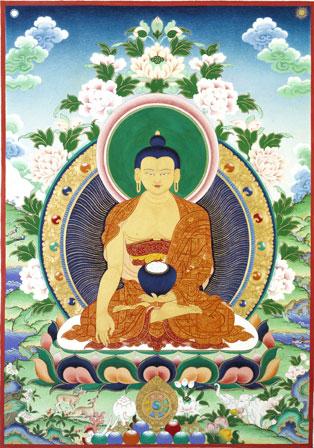
In the language of India: Ārya ṣaḍakṣara vidyā
In the language of Tibet: phag pa yi ge drug päi rig ngag
In English: The Arya Wisdom Mantra of Six Syllables
Homage to all the buddhas and bodhisattvas.
Thus have I heard at one time. At the time when the Destroyer Qualified Gone-Beyond One1 was staying in Sravasti, the Destroyer Qualified Gone-Beyond One said to the Venerable Ananda:
“Ananda, the wisdom mantra of six syllables was set forth by the six fully perfected buddhas, the four world protectors, and the twenty-eight great yaksa leaders. Ananda, hold2 this queen of wisdom mantras of six syllables. Keep it,3 recite it, and understand the meaning of it completely.
TADYATHĀ / DANTILE / KANTILE / DAṆḌIMATI / MADHUMATI / MARAṆḌI / KORAṆḌE / DRĀVITI / KOŚĀRI / CHAṬAJE / DUDUMANI / KETUMATI / CUDUNDHE / KAUṬADANATE / TAHURURE / ENANIGE / HUTAVAHUNI /
“This, Ananda, is the wisdom mantra of six syllables.
“The wisdom mantra of six syllables protects, completely saves, completely protects, and completely guards from being stricken by diseases of the brain, diseases of the eyes, diseases of the ears, diseases of the teeth, diseases of the nose, diseases of the tongue, diseases of the heart, diseases of the stomach, diseases of the back, diseases of the ribs, diseases of the urinary system, diseases of the calves, diseases of the feet, diseases of the limbs, diseases of the secondary limbs,4 indigestion, swelling, obstructions of the womb; sicknesses that arise from wind, that arise from bile, that arise from phlegm, and those that arise from a combination of these;5 extremely serious contagious diseases; contagious diseases of one day, two days, three days, and four days; momentary contagious diseases; contagious diseases of the day, and contagious diseases of the night. It pacifies and brings about happiness and wellness. It frees from punishment, frees from weapons, and neutralizes poison. Ananda, I do not see any beings—devas, maras, Brahma, those training-in-virtue,6 and brahmins or anyone in the world of gods, humans, and asuras—whose heads will not be cracked into seven pieces like the petals of the arjaka flower by the sprinkling with water or binding with thread7 if they transgress this.
TADYATHĀ / AṆḌARE / PAṆḌARE / KARETE / KEYŪRE / BHŪTAṂGAME / BHUTAGRAHE / BHUTAPRAKṢITE / BHUTAYASMARAYANI / PRIYĀVANITE / JAVATI / YAŚOVATI / GIRIṆINI / ŚARĪṆINI / May happiness and wellness arise for me in the face of all danger and harm SVĀHĀ
When the Destroyer Qualified Gone-Beyond One proclaimed this, the One with a Meaningful Life,8 Ananda, and the whole world with its gods, humans, asuras, and gandharvas rejoiced and highly praised what the Destroyed Qualified Gone-Beyond One had taught.
The wisdom mantra called Arya Six Syllables is complete.
Colophon
Translated from the Tibetan by Lama Zopa Rinpoche, Kachoe Dechen Ling, Aptos, in November, 2005. Scribed by Ven. Holly Ansett. Edited by Joona Repo and Ven. Tenzin Tsomo, FPMT Education Services, 2021, based on Ārya ṣaḍakṣara vidyā, 'phags pa yi ge drug pa'i rig sngags, in bka' 'gyur dpe bsdur ma, vol. 90, BDRC W1PD96682, Beijing: krung go'i bod rig pa dpe skrun khang, 2008, 642–645. Final copy edited by Ven. Tenzin Tsomo and Doris Low, FPMT Education Services, November 2021.
Notes
1 Tib. bcom ldan 'das, Skt. Bhagavān. [Return to text]
2 Tib. gzungs. This refers to memorizing the mantra. [Return to text]
3 Tib. chongs. This refers to keeping the mantra on the body. [Return to text]
4 Tib. nying lag. The minor parts of the body, such as fingers and toes. [Return to text]
5 Tib. 'dus pa las gyur pa. [Return to text]
6 Tib. dge sbyong, Skt. śramaṇa, i.e. monks and nuns. [Return to text]
7 The water and thread in this instance would have been blown on with the breath after reciting the Six Syllables mantra. Blessed in this way, the water can also be sipped each day, while the thread can be worn on the body as a protection. [Return to text]
8 Tib. tshe dang ldan pa, Skt. Āyuṣmat. This is a title of respect that is roughly equivalent to “Venerable.” [Return to text]