
Transforming Our Surroundings
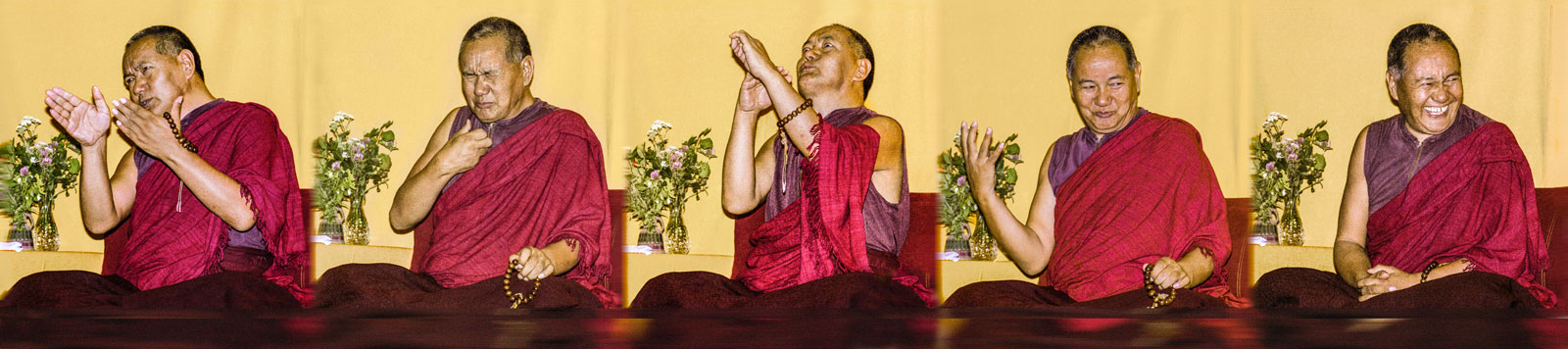
Lama Yeshe explains how we can be happy anywhere by transforming our environment and surroundings, in this excerpt from a teaching in Kathmandu, Nepal, February, 1975. This teaching is published in chapter 13 of Big Love: The Life and Teachings, of Lama Yeshe.

Most of the time, our objects of joy are not limitless; we discriminate. Our minds are funny; they decide, “This one, I like; that one, I don’t.” We divide things into pieces. It doesn’t come from the side of the object; it comes from our own mind’s decision. We see a person and automatically our mind goes, “I’m not happy with him; he gives me no pleasure.” It doesn’t come from him; it comes from your dualistic determination that has already created divisions in your own mind so that when you see people you automatically categorize them. This creates difficulties; it causes conflict and complications and psychological bother.
Do you see how fantastic Lord Buddha’s psychology and scientific understanding of the mind is? How well he explains how the mind works? If you can understand this, you’ll see it’s really too much. It’s amazing; you don’t need too many words to describe it. It’s beautiful ... and really so simple.
Anyway, when we talk about limitless love, we’re not talking about cement; we’re talking about living beings. Most of the time, our conflicts arise from contact with other human beings, each other, not from dogs or cement. Westerners are always going on, “Oh, the environment is no good, that’s why we have problems. This house is no good; this food’s no good. That’s why I’m unhappy.” So much emphasis on externals, which is completely opposite to Lord Buddha’s scientific knowledge-wisdom, the way Lord Buddha thinks.
We should check up our everyday lives here. We always blame outside things for our problems: “Shopping is difficult; Kathmandu is difficult,” and so forth. Actually, this is a deep subject; a very deep subject. It seems simple. It’s not at all simple. If you think about it properly, your ego will freak out; when you actualize Lord Buddha’s teachings, your ego has no space.
I always emphasize how in our daily lives we are always involved with other human beings. If you can see everyone around you as a friend, that will be beautiful. That will be your mandala.1 You’ll be happy wherever you go. In a way, you can say those around you are symbolic of all sentient beings. Look at a person you know; that person symbolizes your mandala. If you can be happy around that person and everybody else you know, perhaps you can be happy anywhere. Experiment, at least in your mind, on the basis of your interactions with that person. Visualize yourself in various situations or in different countries and see. The people around you put you into different situations, so if you check correctly, you can see how you’ll react under different circumstances with other sentient beings. Doing this is really worthwhile.
Notes
1 A mandala is a visual depiction of a sacred universe. Here Lama is using the term loosely to denote “sacred space,” “transformed surroundings” or something like that. [Return to text]