
The Wisdom of Renunciation
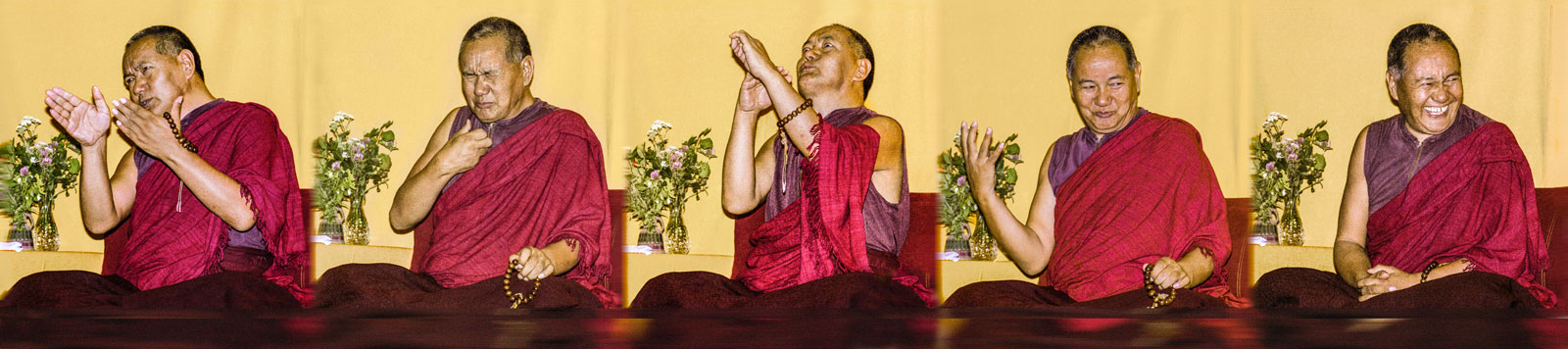
Lama Yeshe explains that we must use our wisdom to check up on the best way to produce happiness in our lives. This teaching from Adelaide, Australia, July 1981, is published in chapter 19 of Big Love: The Life and Teachings of Lama Yeshe.

Now, we are going to talk about the renunciation of samsara. Renunciation is the mind that leads to liberation. That particular renunciation, that specific kind of renounced mind is not easy to achieve. Normally we do have a renounced mind. For example, we try to renounce situations where there is disease, such as tuberculosis or cancer, don’t we? We try to avoid unpleasant situations as much as we can. This is not a specifically human sort of ability. Even insects, dogs, chickens and pigs can do this, can’t they? But if we consider the meaning of renunciation in our human life, it means to renounce the causes of confusion and dissatisfaction—that is, grasping at temporal pleasure and expecting that it will last, permanently, even if you don’t put it into words. Even if you don’t say, philosophically, “My pleasure is going to last a lifetime.” Intellectually you may say, “Of course it won’t last a lifetime, yah, yah, yah,” but inside, psychologically, you’re expecting that your pleasure will last a long time.
But those thoughts are unrealistic. As long you have such an unrealistic grasping attitude, holding such a concept that regards pleasure as permanent and lasting, there is no space to liberate yourself, to achieve eternal peace or whatever you would like to call it. This is why renunciation is a little bit heavy for you. But that’s the way it is. What do I mean by heavy? Heavy means quite difficult to understand, because the ego doesn’t want to understand this. Because normally we see pleasure only in that unrealistic way. That is what is real for us. We don’t see anything else, any other alternative.
However, from the Buddhist point of view, in order to discover eternal peace or liberation it is essential to eliminate the desire that craves temporal pleasure. Otherwise, our situation is endless. Remember, we’ve talked about the cycle of existence; that’s what samsara means. We repeat our situation again and again, which gets us nowhere. The only result is dissatisfaction. Now, according to Buddhism, we need to use our intelligence. In a way, Western society means well, using the intellect to develop whatever is best to give you the most pleasure, isn’t it? This is what we are chasing. We try. Similarly, Buddhism says that human beings can achieve indestructible peace and pleasure. We are capable. The problem is that we are always grasping for small pleasure, which interferes with our being able to discover everlasting pleasure and peace.
That’s why you should use your wisdom to check up what is the best way to produce happiness in your life, in your mind. That’s the main point. We waste our life by focusing on temporary business that results in such little pleasure. We spend so much energy and effort but the result is almost all confusion. This is what we do. I do this too, even though I am monk. Check up. You check up.
So now, those who understand, those who have realized renunciation of samsara, no longer have any ambition for something missing. Do you understand what I mean? Normally, it doesn’t matter how much pleasure we experience, we still always feel like something is missing, but those who have really gained a deep realization of samsara no longer have this kind of ambition. They don’t wish for New York pleasure, they don’t wish for California pleasure, they don’t wish for Australia pleasure. Once you have reached that understanding, you can rest. You can rest because there is less contradiction in your mind. That’s the way to be liberated.
Most of the time we are so limited; we use such a limitation mind. For example, first I think, “Well, now that I’m old enough, I should get a fantastic car—maybe a Mercedes.” This is ambition. Then when I get my Mercedes, vroom, vroom! I use it to go, don’t I? I use it for my ego. “Is somebody looking at me, at my car? Aaah, nobody’s looking.” Well. But this is still limited pleasure. Even getting a Mercedes, having things in life, you know, sometimes you’re still bored, aren’t you? You get bored. It’s not a great achievement nowadays to have a Mercedes. Once we’ve bought something, we immediately start looking for something else. What else can we do? That’s the way our life is.
With any kind of worldly pleasure we somehow end up dissatisfied. Yet we still try to cope. “Today I’m dissatisfied but I hope that tomorrow I can get satisfaction.” We are always hopeful. “I hope that tomorrow everything will be all right.” We live our entire life like this. It never ends. From the Buddhist point of view, not only do we renounce grasping at pleasure, we also renounce grasping at ambition. Not only do we renounce grasping at pleasure, we renounce even grasping at our own body.
We generally think of our body as the most important thing in the world. We spend so much time and effort building up our ego. But these things are all temporary, so temporary ... like a flower. A flower exists because of the coming together of the four elements in a particular way. But a flower grows, gets old, decays and dies. Just like our body. We have to accept this reality.
Thus our dear body and our precious material things are all a kind of big deal for us. We dedicate all our time and energy trying to please our body, trying to please our ego, trying to get material possessions. But the result of all this effort is so little, the result is so small.
The renounced mind is not something too specific, like renouncing chocolate cake or honey or something. That’s not enough. That has nothing to do with the connotation of renunciation of samsara, which leads you to perfection and liberation. That’s why I have interpreted it as no ambition, no driving force for gaining worldly pleasure. Your mind is clean-clear.
Take, for example, somebody who goes dancing and has an incredibly pleasurable time. When you have a renounced mind, you understand that situation thoroughly. You know how people who go dancing appear as if they are experiencing such pleasure and you know how that pleasurable situation will turn into misery. And because you know, you are more reasonable. But if you don’t understand the nature of all these different pleasurable situations and the mind that grasps them as permanently pleasurable, then you are filled with superstition. Because you are ignorant, you have superstitious thoughts: maybe I can become a Hollywood actor; those people must be happy. They act like they’re happy, don’t they? But why would you think that? You know Hollywood people’s history. Relatively, you know what it is.
So, this is the point of what I’m telling you. To renounce samsara means fully knowing every samsaric trip, knowing the reality of the ego and how it is stimulated by the polluted mind. By knowing, you can be liberated.