
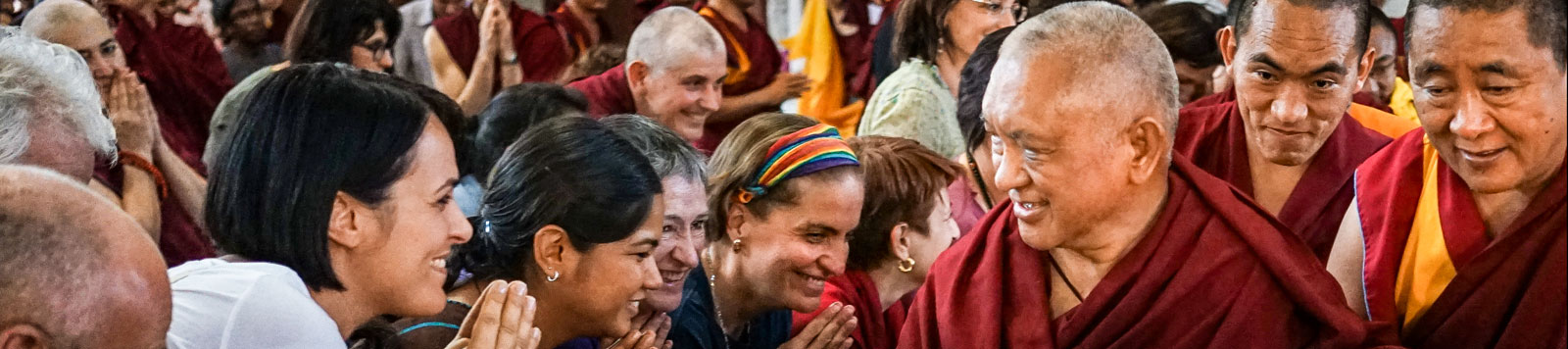
The Path to Enlightenment
Generate the Path to Enlightenment in Your Heart
In this letter, Rinpoche advised a student to study and practice lamrim, beginning with guru devotion, the root of the path. Rinpoche also recommended preliminary practices and explained that renunciation and bodhicitta are essential foundations for attaining enlightenment.
My most dear, most precious, most kind, wish-fulfilling one,
Thank you very much for your kind letter, and for expressing very clearly what you want to do. This is very positive. Also, thinking that death can happen at any time, therefore you need to practice Dharma. That’s a normal thing, but you want to achieve enlightenment before you die, which means you want enlightenment in this second, because your death could happen in the next second.
[To attain enlightenment] we need to achieve the total cessation of gross and subtle obscurations. The gross obscurations mainly interfere with achieving liberation from samsara, and the subtle obscurations mainly interfere with achieving the state of omniscience and the completion of realizations. In order to actualize that, we need to actualize the whole path to enlightenment, the lamrim.
Buddha taught 84,000 teachings and these come in three paths: the Lesser Vehicle path, the Greater Vehicle path of sutra and the Greater Vehicle path of tantra. All of these teachings are embodied in the lamrim, the graduated path to enlightenment, which also comes in three levels: the graduated path of the lower capable being in general, the graduated path of the middle capable being in general, and the graduated path of the higher capable being. These, in turn, are embodied in the three principal aspects of the path to enlightenment.
Lama Tsongkhapa gave teachings on this, so it’s extremely important to learn and understand the commentaries very clearly. I’m going to explain it to you here. It’s good for me to know where you are—which country and which area—because within the FPMT, our organization, there are Dharma centers with geshes. You have to learn, so [it’s important] that you connect with a geshe.
Otherwise, if you have questions you can ask Geshe Namdak, a Westerner who studied very well at Sera Je Monastery, where there are many thousands of monks, many learned ones. He did the examinations and finished everything, and now teaches many people online. He is a qualified monk who knows philosophy.
You need to study Liberation in the Palm of Your Hand. Read it twice, doing it mindfully so that it becomes a meditation. If you don’t have a copy of that text, you should try to get one.
In terms of effortful lamrim meditation, begin with guru devotion, which is the root of the path to enlightenment. Spend four months going through the outline of this subject according to Liberation in the Palm of Your Hand. Another meditation guide you could use is The Essential Nectar.
Liberation in the Palm of Your Hand is the main commentary, but of course, you can read other texts from Lama Tsongkhapa’s lamrim. There are many other lamrim teachings that you can integrate into the Liberation outline or into The Essential Nectar outline, which is also a meditation guide.
Except for shamatha, the rest of your meditation is analytical. For example, in guru devotion section there’s analytical meditation using reasons and quotations, so at the end, when you finish, you see the guru and buddha as one. Before, you were seeing the guru and buddha as separate, but then after all the meditation, after going through the quotations and the logic using analytical meditation, your mind sees that the guru and buddha are one.
Keep the mind in that state for a while, so that’s the fixed meditation. It’s the same for all the rest of the lamrim meditations, except shamatha. Do effortful meditation on the lamrim outline, repeating the cycle four times in total, then do effortless meditation.
These realizations of the graduated path to enlightenment happen [gradually.] For example, if we want to go to the sixth or seventh story of a house, or even to the hundredth story, we have to go up either by using a lift or by using steps. We have to use the steps or the lift and go up gradually; we can’t just jump there. So the path to enlightenment is like that. To actualize realizations, we need to purify the defilements and obscurations, and collect merit.
In order for these realizations to happen, you will need to do these preliminary practices.
- Dorje Khadro fire puja: 50,000
- Prostrations by reciting the names of the Thirty-five Buddhas: 200,000
- Mandala offerings: 70,000, and
- Vajrasattva mantras:130,000.
It would also be very good if you could do one hundred nyung näs. Perhaps you haven’t done nyung näs before. If not, you should first join with other people, then afterwards, when you are able to do it well, when you know the practice very well, you can lead it for others. Nyung nä is a two-day retreat in which you take the eight Mahayana precepts for both days. With bodhicitta and the eight precepts you collect merit more than the sky. It’s unbelievably, unbelievably beneficial for sentient beings, for them to be free from samsara and to receive enlightenment. It’s unbelievable, unbelievable, unbelievable.
This practice helps to pacify war, famine, disease, and the dangers of earth, water and fire, all these things in the world. Actually, you need to receive a Chenrezig great initiation in order to be qualified to do the nyung nä well, correctly. Otherwise you can’t visualize yourself as Chenrezig, the Compassionate Buddha. I hope you have received this initiation.
Reciting OM MANI PADME HUM is incredibly powerful; it purifies all the defilements and negative karma collected from beginningless rebirths, and collects more than skies of merits, especially if you recite the mantra with bodhicitta, even if you recite it just one time.
There are so many prostrations to the Thirty-five Buddhas. Reciting the Thirty-five Buddhas’ names and reciting them well—not only reciting, but doing the meditation—even one time, has the power to completely purify the five heavy negative karmas of killing one’s father, killing one’s mother, killing an arhat, causing blood to flow from a buddha and causing disunity among the Sangha. These heavy karmas are totally purified because the practice contains the remedy of the four opponent powers, as long as it’s done mindfully.
Normally, if we have committed any of the five heavy negative karmas, as soon as we die we will be reborn in the lowest hot hell, where we have to experience suffering for one intermediate eon. Even if this world finishes, if our karma is not finished we will be reborn in another universe in that hell. So it’s like that. By reciting the Thirty-five Buddhas prayer one time and meditating well, our negative karma is purified. It’s unbelievably powerful, unbelievably powerful, so this is a quick way to achieve enlightenment.
We had one geshe here, Geshe Lama Konchog, who did two thousand nyung näs. Also, we have one nun here at Kopan—if you want a picture you can get it—who did more than two thousand nyung näs in Tsum, near Tibet, before coming to Kopan. She’s such a fortunate being who has brought so much benefit to sentient beings. She said she has no worries about death; she can go straight to the pure land and then after that achieve enlightenment.
I want to tell you one thing. Yes, you are right, death can come at any time, so you want to achieve enlightenment before that. But it’s not like taking tablets for enlightenment. It’s not like taking medicine or taking tablets and then you are unconscious, or receiving an injection and then you die. It’s not like that.
You have to generate the whole path to enlightenment in your heart. This is the remedy that purifies the gross and subtle defilements. If you could purify all the defilements in one second, then you could achieve enlightenment in the next second.
Actually, Buddha taught everything, and now it is up to us to practice, whether we practice correctly or not, so that’s why first we have to learn. Without knowing how to drive to Tibet, for example, or how to travel there, just entering the airplane, then in the next second arriving in Tibet, there’s no such thing. So whichever country we go to, we have to know the way, whether it’s by airplane or car or whatever, therefore we need to study the lamrim.
Your idea is correct. Yes, death can happen at any time, therefore we need to practice holy Dharma day and night, all the time. Our body, speech and mind have to be Dharma; our actions of body, speech and mind have to become Dharma. [Our actions] should not become the cause for the lower realms, the cause for samsara or for lower nirvana, therefore we need to generate bodhicitta, the root of the path to enlightenment.
By having bodhicitta, every action of our body, speech and mind becomes the cause of enlightenment, then we actualize the whole Mahayana path to enlightenment. Before that, we need to actualize renunciation of samsara, our own samsara, recognizing that it is in the nature of suffering, like a naked body sitting in a nest of thorns or in the midst of a red-hot fire, or sitting on an upturned needle in the ground. We must recognize that samsara is like that.
There’s no happiness for even one second in samsara; it’s all suffering. There’s the suffering of pain that we recognize and that animals recognize, and the suffering of change, how all the samsaric pleasures are in the nature of change. Then those two sufferings come from pervasive compounding suffering. That means our aggregates are totally under the control of delusion and karma from beginningless rebirths, and that’s why we’ve been suffering all the time, until now.
From the contaminated aggregates, which are contaminated by the seeds of disturbing thoughts and karma, so from these seeds, delusion arises, then suffering arises again and again. That’s why we need to actualize lamrim.
Thank you very much. How quickly you achieve enlightenment depends on how quickly you achieve bodhicitta, and that depends on how quickly you develop renunciation, so you need to actualize the path, starting with guru devotion.
If you can, read the Arya Sanghata Sutra twice each week, mindfully, then you’ll understand; you’ll collect unbelievable, most unbelievable, most unbelievable merits, wow, wow, wow, and that’s how you’ll achieve realizations more quickly. Through being able to control the negativities, the wrong concepts, and doing purification, then it becomes easy to achieve the realizations and enlightenment.
Thank you very, very much. You are most welcome to enlightenment and goodbye to samsara. As I mentioned earlier, if you have questions arising from Liberation in the Palm of Your Hand, you can ask Geshe Namdak at Jamyang Centre in London.
With much love and prayers ...
Four Levels of Renunciation
A student who practiced according to the Drikung Kagyü and Nyingma lineages asked Rinpoche for advice. Rinpoche explained that the four Tibetan schools (Kagyü, Nyingma, Sakya and Gelug) are the same in essence.

My most dear, most precious, most kind, wish-fulfilling one,
Thank you very much for your letter. You explained that you practice Drikung Kagyü and Nyingma, and that you’re very interested in getting an answer from me about your practice. You’re most welcome; no problem at all.
You can achieve enlightenment through all the four sects. I will explain according to my observation. All the 84,000 teachings of the Buddha are embodied in the Lesser Vehicle teachings and the Greater Vehicle [Mahayana] teachings of sutra and tantra.
Because sentient beings have different levels of mind and not everyone is at the same level, these three extensive teachings are embodied into the lamrim, the graduated path to enlightenment. The lamrim has the teachings of the graduated path of the lesser capable being in general, the graduated path of the middle capable being in general and the graduated path of the higher capable being. All of these are embodied into the three principal aspects of the path to enlightenment—renunciation, bodhicitta, and the right view [of emptiness]—according to Lama Tsongkhapa.
Instead of having renunciation of this life, then renunciation of the next lives and separating them into two, they are put into one category, the renunciation of samsara, so that’s interesting. First there is renunciation for Dharma, which means renouncing attachment to this life, praise, reputation, receiving materials and so forth. We have attachment to this life and as much as there’s attachment, that much more there’s dislike of the four opposite things: the discomfort of this life, not receiving praise, having a bad reputation and not receiving good reputation, or not receiving materials.
So you can see what brings life up and down so much for people in the West. It’s a good example of Western life, going up and down all the time, every day. This is because of not renouncing attachment, clinging to this life, so these things happen. This is the root and it causes hundreds, thousands of problems in the life. By renouncing this, you renounce all the problems that spread like roots. Instead, there’s incredible peace and happiness in this life as you’re living in pure Dharma practice.
The Nyingma and Kagyü traditions also have four things that need to be renounced, which correspond to the four levels of renunciation. They are:
- Renunciation of attachment to this life and future lives [equivalent to the path of the lower capable being].
- Renunciation of attachment to samsaric perfections [equivalent to the path of the middle capable being].
- Renunciation of the self-cherishing thought, so then there’s bodhicitta [with the next one, equivalent to the path of the higher capable being]
- Renunciation of ignorance, the root of samsara, which means the ignorance holding the I, action, object, all the phenomena as real, as things appear from there to our hallucinated mind. So that is the wisdom realizing emptiness.
In the Sakya tradition, there’s Parting from the Four Clingings (Wyl: zhen pa bzhi bral). [They are: If you cling to this life you are not a Dharma practitioner; If you cling to future lives’ samsara you mind is not in renunciation; If you cling to the I, that is not the right view; If you cling to cherishing the I, that is not bodhicitta.] It’s not all attachment; you have to know that. The self-cherishing is not attachment; holding things as real while they are not is not attachment.
In Tibetan language zhen pa means clinging, so the title is Parting from the Four Clingings. When it goes into the detail, it’s not clinging, those last two are not clinging—the self-cherishing thought and ignorance, holding things as real, as they appear to the hallucinated mind. That is a totally ignorance concept.
Ti muk den dzin ma rig pa means holding [the view of] true existence when there’s not one atom of true existence, and all these things exist in mere name. Negative karma and good karma are created in mere name, and the resultant suffering and happiness are experienced in mere name. Similarly, achieving the great liberation from samsara, achieving great nirvana, enlightenment, is in mere name.
Therefore, there’s all this, just having different names, but it’s all the same [in essence]. So when you study lamrim, it touches all the teachings of the Buddha. It says when you read lamrim, all the teachings get moved, so that means it’s the essence of all the teachings; it touches all the teachings; it’s the essence.
My suggestion is for you to study Lama Tsongkhapa’s Middle-Length Lamrim. If you can, please study this text three times from beginning to end.
In terms of effortful practice, please read my advice on how to meditate on the lamrim. Keep going step-by-step through the lamrim outline for the path of the three capable beings. Circle through the outline and repeat this three times.
Also do the following:
- Vajrasattva: 30,000 recitations;
- Mandala offerings: 300,000 times;
- Sutra of Great Liberation: Recite this at least once each week for your whole life, if possible. It has the most unbelievable, unbelievable benefits. Just by hearing the name you don’t get reborn in the lower realms, it’s unbelievable.
So that’s it. You are most welcome to enlightenment. Goodbye to samsara.
It appears that you must already have your main deity. Since you’ve been practicing for a long time, you must have your own deity.
With much love and prayers ...
How to Meditate on the Graduated Path
Rinpoche gave this advice on how to meditate on the lamrim, the graduated path to enlightenment, until realizations are attained.
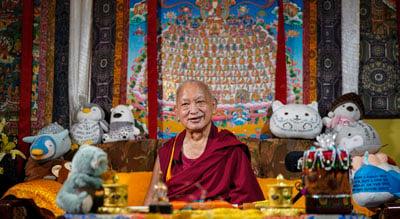
With regards to your meditation, you can train your mind in generation stage until you see all gurus as a buddha and all buddhas as guru, until you have very strong, stable devotion. Not just for a few hours or a few days, but spontaneously arising from the heart. You must work on guru devotion every day. This should be one fundamental practice.
On top of that, [meditate on the lamrim] until you feel all the works for this life are not important and you have no wish to gain a good reputation, comforts, materials, happiness of this life, etc. You need to understand that death can happen any moment, any day, therefore the works for this life have no meaning and are nonsense and childish. Until you get these realizations you should work on the graduated path of the lower capable being.
Meditate on the general lower path of the lamrim, until you get this understanding spontaneously arising in the heart. Then you will see that samsara is how prisoners feel when they are imprisoned. Day and night they naturally want to be free from prison and have the intense wish to get out. Or it’s like your naked body is sitting on a thorn bush or in a nest of poisonous snakes or a fire. Like that, you should feel that samsara is unbearable and you don’t have the slightest attraction to samaric pleasures, even in a dream. When only the wish to be free from this is spontaneously arising in the heart day and night, this realization is renunciation.
You should also meditate on the true cause of suffering, the true cause of the shortcomings of samsara, delusion and karma, also the three, four, and six types of general sufferings of samsara, the twelve links, and the sufferings of the individual samsaric realms.
[Meditate on bodhicitta] until you feel like the mother feels towards her beloved child, as the most precious one in her heart, and whatever problem the child has, even if the child is drowning or is in a fire, the mother herself would jump in and rescue her child by herself alone. So like that, a stable strong feeling simultaneously arises from the bottom of heart for all sentient beings without exception. Not only wishing sentient beings to be free from suffering but wishing to cause it by yourself alone, wishing to free all sentient beings from suffering and achieve full enlightenment for all sentient beings by yourself alone. For that purpose, you need to achieve enlightenment. This thought needs to arise spontaneously, without effort, day and night, all the time. This is refuge. You must meditate on bodhicitta until you get this realization.
The unmistaken realization of emptiness is when you can see subtle dependent arising and emptiness as one object; that things exist depending on base and thought as labels. The generation stage is when you have the realization that any time you want to see yourself as the deity and mandala it automatically happens without the slightest effort, as explained by Kirti Tsenshab Rinpoche. Everything, every detail is very clear. Also being able to concentrate for hours without a single thought entering—without attachment-scattering thought.
This is how to go about meditating in order to attain these realizations. Without realization of renunciation, you can't have realization of bodhicitta. So you need to work on renunciation by doing analytical meditation on renunciation, bodhicitta and emptiness, also guru devotion and generation stage. This is what you can do from now.
Do as many of these meditations as you can each day.
Life Practices After Guru Passed Away
A student had completed a number of preliminary practices advised by another lama, who had now passed away. The student ask Rinpoche for advice on how to progress on the path.
My most dear, most precious, most kind, wish-fulfilling one,
Thank you very much for your kind letter. Please find attached my advice for your life practice, what to focus on.
For you, the main text to use, like a bible, the main one to focus on for your life is the Lamrim Chenmo, the great commentary of the lamrim. Please study this text from beginning to end, reading it through a few times. There is also the commentary on the Lamrim Chenmo.
If possible, read the text through nine times, otherwise just do as much as you can. Read it from beginning to end, and anything that you don’t understand or that you have questions about, write this down in a notebook and then you can ask a geshe or a student who has studied the lamrim a lot. So this is the way to learn the lamrim. When you are meditating on the lamrim you can use either the Lamrim Chenmo outlines or The Essential Nectar as a guide. Of course, you can read other lamrim texts, but the main one for you is Lamrim Chenmo.
Please read my advice about how long to spend on each section of the lamrim. Go through this cycle twice, then do effortless meditation.
If you can, do Lama Chöpa Jorchö practice in the morning, but if you are very busy and you don’t have time, you can do Lama Tsongkhapa Guru Yoga instead. Finish the whole thing, Jorchö or Lama Tsongkhapa Guru Yoga. When you get to the lamrim prayer, stop and meditate on the lamrim, according to the amount of time you need to spend on each section of the lamrim.
Your main deity to practice is Vajrayogini. In order to bring sentient beings as quickly as possible to enlightenment, for that you need to achieve enlightenment as quickly as possible, and for that you need to practice Highest Yoga Tantra, Vajrayogini. Before you can take Vajrayogini initiation you need to receive another great initiation. The best for you is Heruka, and if not, then Yamantaka or Guhyasamaja or Kalachakra, but you must be taking it as an initiation, not just as a blessing.
This is how to make your life most meaningful. Even if you learn the two hundred volumes of the Kangyur, the Buddha’s teachings, or the one hundred volumes of the Tengyur, the commentaries from Nagarjuna, Asanga and other ancient holy great pandits; even you study them all and know them by heart, the essence of all of the teachings—of the entire Kangyur and Tengyur—is the lamrim. We need to practice or integrate the lamrim in our life.
Even if we study all the sutra and tantra, the whole essence is the lamrim—correctly following the virtuous friend, renunciation, bodhicitta and right view. This is the essence of all the sutras and the two stages of tantra. After actualizing bodhicitta, then you can put more effort in tantra.
Practices
- Prostrations by reciting the names of the Thirty-Five Buddhas: 300,000. [See Confession of a Bodhisattva's Downfalls to the Thirty-Five Buddhas.]
- Lama Chöpa Jorchö: Do this daily. If you don’t have enough time for that, do Lama Tsongkhapa Guru Yoga.
- Nyung näs: Do at least eight nyung näs each year, and if you can, do more.
- Tonglen: 9,000.
- Tsa tsas: 100,000. Deities: Tara and Medicine Buddha.
I feel you are a very sincere person, so that’s why I am explaining this. It seems you do exactly what you are told by the guru, so that is very, very good. That is the most important thing. Please try to do this according to my advice. Then sometimes if you have questions, please ask.
With much love and prayers ...
The Four Seals
After a teaching, Rinpoche dictated this advice about the four seals, the core tenets of Buddhism. Rinpoche asked for this advice to be given to all the students who had attended his talk.
My dear brothers and sisters and students,
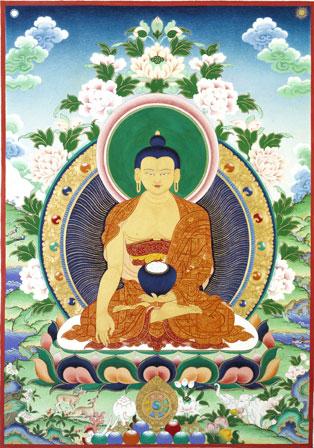
I am very sorry, when I was giving teachings in the gompa I did not explain completely the four mudras of sealed instructions [the four seals]. It is so important that I mention this. It is an excellent meditation, other than bodhicitta.
I did explain more on emptiness during my talk, but I forgot the last one of the four mudras of sealed instructions, the view. These are the four:
- All contaminated phenomena—mainly the aggregates—are suffering in nature.
So, all the meditation on the suffering of samsara comes there. What is basically mentioned in the lamrim, everything comes there. - All causative phenomena are in the nature of impermanence.
- All phenomena are empty.
I explained this according to Madhyamika Prasangika. All phenomena are empty, no self. - Nirvana, the sorrowless state, is peace, isolation from samsara.
This is what I forgot, the fourth one. This is the result that we achieve by meditating and realizing the previous three mudras of sealed instructions, the view.
Of course, this is all based on the foundation of Buddhadharma, the Lesser Vehicle teachings. Then on that basis, we practice bodhicitta, the root of the Mahayana path to enlightenment, and then we achieve the total cessation of even the subtle obscurations and completion of realizations.
It would be very good for the people who came to the teachings that day to gather, to come and have discussions and meditation. It would be so nice and very helpful—inspiring each other, helping each other.
Even if you cannot practice, it is extremely important to explore Buddhism. In the world, so many people explore meaningless things for their whole life. So here, you explore the Omniscient One’s teachings, the path and develop yourself. You can fully develop the potential of the mind, in order to be able to perfectly benefit sentient beings.
With much love and prayers. You are most welcome not only to liberation from samsara, all the oceans of samsara suffering, but to buddhahood, the total cessation of obscurations and completion of realizations.
With much love and prayer ...
Goodbye to Samsara
A student wrote that their goal was to attain lamrim realizations and to focus on calm abiding and mahamudra. The student asked Rinpoche if it would be best to retire soon so they would have more time for retreat and practice.

My most dear, most precious, most kind, wish-fulfilling one,
Thank you very much for your kind letter. I am very happy that you are involved in the practice of Dharma. As Lama Tsongkhapa mentioned, this is only one time you have received a perfect human body.
First of all, a human body is extremely rare and even more rare is the qualified human body with eight freedoms and ten richnesses. This is extremely rare. So it’s a most incredible opportunity to practice Dharma, to realize emptiness and especially to actualize bodhicitta, which makes the life most beneficial for every sentient being, not only for you, but for every single hell being, every single hungry ghost, every single animal, every single being that can be seen, that you see in the ocean, the smallest—I’ve heard, but I don’t know the name—that you see with machines, and the large whales like mountains, and the many kinds of beings that look like flowers, like rocks, like plants. Then in the ground, in the bushes, there are tiny insects, the flies in the sky, the insects in people’s bodies and animals’ bodies, and in the trees outside. There are all kinds, all kinds. Even [parasites] are sentient beings, by going into the body through the mouth and causing disease. Also, every single human being, sura, and asura being, intermediate state being. There are also numberless universes, I’m not only talking about this world.
As you might know, by following the Lesser Vehicle path, that doesn’t teach bodhicitta, so there’s no enlightenment, only liberation from samsara, lower nirvana, only the four noble truths. On the basis of renunciation of samsara, we see how it’s filled with the nature of suffering and we see how other sentient beings are suffering in samsara, then we generate great compassion. Then from great compassion, bodhicitta arises, the thought to achieve enlightenment for sentient beings, for them to be free from the oceans of samsaric suffering and to bring them to enlightenment.
On the Mahayana Sutra path we have to collect the merit of wisdom and the merit of virtue for three countless great eons. We have to do both together, but not by one mind. [By following this path] it takes three countless great eons to complete the two merits and achieve enlightenment.
In tantra, in the two lower tantras, Kriya and Charya tantra, there’s a special path or technique for one mind to practice wisdom and virtue, so in one life we can achieve enlightenment. We can complete the merits of wisdom and virtue in one life, because Vajrayana means one mind practicing method and wisdom together, so that’s what makes us achieve full enlightenment in one life.
For example, after we purify in emptiness, then we generate into the deity. That wisdom generates into the deity, so that mind is focusing on the deity, on that aspect, the deity’s holy body, that is method, and at the same time being aware of the nature of the deity’s holy body. Even though it appears to exist from its own side—it appears that way for sentient beings—we don’t believe in that, we don’t apprehend that.
For example, while we’re dreaming, recognizing it’s a dream. Or we cross the sand and when we look back, it looks like there’s water running, but there’s no water, it’s due to the sunlight on the sand. When we look back it looks like there’s water, but it just comes from that [mirage]. So there’s no clinging, thinking, “There’s water running.” So like that. That’s the wisdom. That is according to the sentient being, not an enlightened being.
We realize the nature of the deity’s holy body is empty, that it does not exist from its own side, but at the same time, it is like that. It exists, but it’s like it doesn’t exist. It’s unbelievably subtle, it’s like it doesn’t exist. That’s not the way it’s explained. One mind is practicing method and wisdom together, so that ceases the obscurations and brings our mental continuum to enlightenment, to buddhahood.
Vajra is the one mind practicing method and wisdom together. Vajra, inseparability, and yana is the vehicle that is bringing us to enlightenment. So we can achieve enlightenment in one life even with lower tantra.
So now highest tantra is the same, but the mind realizing emptiness, the subtle mind experiences great bliss nondual in emptiness. Focusing on the deity’s holy body, method, then the nature of that is empty. It doesn’t exist from its own side, it’s totally empty, and we see that. The nature exists but it’s like it doesn’t exist, it’s unbelievably subtle.
There’s no nature from there. “From there” means truly existent, the real one, but it’s merely imputed by our mind. While we’re seeing this, it’s empty. It appears to exist from its own side, but the apprehension that it’s true is completely false and we see that nature. So that’s one mind practicing method and wisdom together, unified. So then through that path we achieve the result, the unified holy body and mind. By practicing the Maha-anuttara Yoga path, then we achieve buddhahood, the unified state of Vajradhara in one brief life of degenerate times.
According to my observation, your main deity is Yamantaka. Also, according to my observation, for you to come to realize emptiness, it seems you have a good opportunity for that. So, work hard on that and meditate on emptiness every day.
Regarding shamatha, it doesn’t seem you will have much success. With shamatha, there’s the actual realization, fully characterized, then there’s another similar one, but that may be difficult. It’s good to try that, leave it like that, then you know how to meditate.
I suggest that you study the lamrim text, Liberation In The Palm Of Your Hand, from beginning to end. Just do it one time. If your goal in this life is bodhicitta, then you need to have renunciation before that. Renunciation means future life’s renunciation and this life’s renunciation. So this life’s renunciation is the first Dharma, Buddhadharma, unstained by worldly concern.
Your practice, your realization, has to start with correctly devoting to the virtuous friend, seeing the guru as the deity, seeing the guru as a buddha using logic and quotations, then looking at the guru as a buddha. That realization becomes the root of the path to enlightenment, then you need to have the realization of renunciation, the graduated path of the lower capable being in general, then the graduated path of the middle capable being in general and then the graduated path of the higher capable being.
In terms of effortful lamrim practice, go through the lamrim outline five times.
Also do 80,000 prostrations by reciting the names of the Thirty-five Buddhas. You can do this sometimes in the form of a retreat, with three or four sessions, then at other times if you are working you can do one or two sessions. So you can finish the prostrations like that, sometimes in retreat and sometimes more loosely.
For effortless practice, even if shamatha realization doesn’t happen, it’s good to know how to do the meditation. You need some idea of that, knowing how to meditate, how to overcome at least the gross sinking thought and the subtle sinking thought, like that.
The other important thing is to do everything—eating, walking, sitting, sleeping, doing your job, studying, everything—with bodhicitta, the thought of benefiting sentient beings. That’s so important. If you have bodhicitta realization, of course everything is for sentient beings, even breathing, each breath.
Even if you don’t have bodhicitta realization, you can attempt to practice it as much as possible. That’s so important. Then everything—eating, walking, sitting, sleeping, doing your job, everything—becomes a cause of enlightenment. That means everything becomes a cause of happiness for sentient beings, then enlightenment and their enlightenment, that’s the most important. Collect much merit and pray to generate bodhicitta in all the lifetimes, like that.
Again, according to my observation, retirement is best for you. Then you can spend more time on Dharma, on lamrim practice. You are most welcome to enlightenment, and goodbye to samsara. [Welcome to] lamrim practice and goodbye samsara.
If you have important questions, you can ask me and I’ll try to answer as best I can.
With much love and prayers ...