
E-letter No. 269: November 2025

Dear Friends,
We hope you are safe and well, and we truly appreciate you showing up and staying connected. We are so grateful for your generosity over Lhabab Duchen and want to offer heartfelt thanks to everyone who contributed to our year-end campaign kick-off. Thanks to your kindness, we’ve already raised more than $7,000 toward our $50,000 goal—we’re off to a fantastic start, and it’s all because of you!
In this issue we’re featuring a short video excerpt of Lama Zopa Rinpoche, a podcast teaching on how Western psychology can benefit from understanding karma, newly published excerpts from Big Love, and fresh additions to Lama Zopa Rinpoche’s Online Advice Book. We’re also excited to share a fun new project: short video excerpts of Lama Yeshe’s students recalling their memories of him. Plus, we have updates on our key priorities for continuing the vital work of preserving the Lamas’ legacy.
Preserving the Enduring Wisdom of Our Lamas

Inspired by the compassion and clarity of Lama Yeshe and Lama Zopa Rinpoche, we are working together to ensure the Lamas' wisdom remains accessible across cultures and generations. One of our key 2025 priorities is a renewed focus on preservation. This includes training new transcribers, manage collections on a secure digital platform, improving searchability, and partnering with FPMT to map out the future of this essential work. Read more about it in the LYWA Strategic Plan 2025.
As we continue our year-end appeal, we invite you to help preserve this precious legacy by supporting the transcription of remaining teachings, the strengthening of our digital archives, and the long-term safeguarding of this irreplaceable source of Dharma for future generations. Together, let’s preserve our Lamas’ Dharma legacy!
From the Video Archive: The Heart of the Practice
In this 2002 teaching hosted by the Amitabha Buddhist Centre in Singapore, Lama Zopa Rinpoche explains how maintaining the right motivation and attitude is the key to transforming our whole life into Dharma practice. Rinpoche urges us to take our Dharma practice off the cushion and into every moment of daily life. By bringing the three principal aspects of the path: renunciation, bodhicitta, and the wisdom of emptiness into ordinary activities like shopping, working, and family life, every action becomes a cause for genuine happiness.
Visit and subscribe to the LYWA YouTube channel to explore our complete video collection of teachings by Lama Yeshe and many from Lama Zopa Rinpoche, available from our archive. For many more videos of Lama Zopa Rinpoche's teachings, visit the FPMT YouTube channel.
On the LYWA Podcast: Ignore Karma at your own peril
When the subject of karma is missing, there's no understanding that harming others means harming oneself.
—Lama Zopa Rinpoche
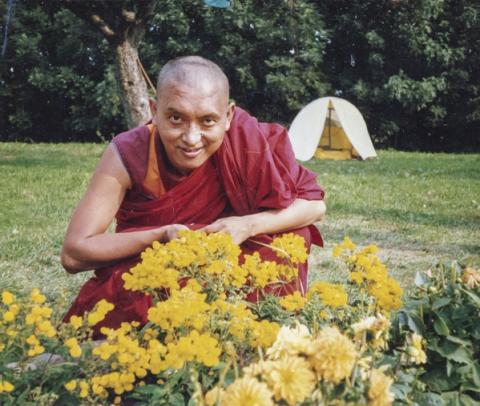
This month on the Lama Yeshe Wisdom Archive podcast, Lama Zopa Rinpoche explains how Western psychology falls short without an understanding of karma. He emphasizes that helping a patient in a psychological consultation to feel superficially better is not enough if the deeper causes of suffering remain unaddressed. These teachings were given during a lamrim course at Maitreya Instituut in Emst, the Netherlands, in August 1990. You can read along with the transcript on our website.
The LYWA podcast contains hundreds of hours of audio, each with links to the accompanying lightly edited transcripts. See the LYWA podcast page to search or browse the entire collection by topic or date, and for easy instructions on how to subscribe.
What's New On Our Website

This month we’ve added two new teachings from Lama Yeshe, excerpted from Big Love: The Life and Teachings of Lama Yeshe. In our first excerpt, Intention: Your Mental Attitude, featured as our monthly teaching below, Lama Yeshe discusses setting the proper intention and problems associated with the discriminating, narrow mind. In the second teaching, Understanding Delusion, Lama Yeshe talks about the nature of delusion and the importance of understanding relative conventional reality.
Visit our new Big Love Teaching Excerpts webpage, where you’ll find a growing selection of teachings featured in the book. The teachings are organized by chapters, with easy navigation links. Check back often, as we’re adding new content every month!
Be sure to explore the new entries we’ve added this month to Lama Zopa Rinpoche’s Online Advice Book. With more than 100 new pieces of advice published each year, the collection has now grown to over 2,600 entries on our website.
- Four Levels of Renunciation: This letter was sent to a student who was following the Drikung Kagyü and Nyingma lineages and had asked Rinpoche for advice.
- Read Lamrim Chenmo Mindfully: A student wrote that a difficult upbringing had left them with deep trauma. Rinpoche responded with a long letter advising lamrim study and other practices including one thousand nyung näs.
- Your Life Has Become an Inspiration: A new student was doing many hours of Dharma practice every day. Rinpoche praised their efforts and advised practices for their lifetime.
You can always find a list of all the newly posted advices from Lama Zopa Rinpoche on our website.
Sharing The Family Feeling
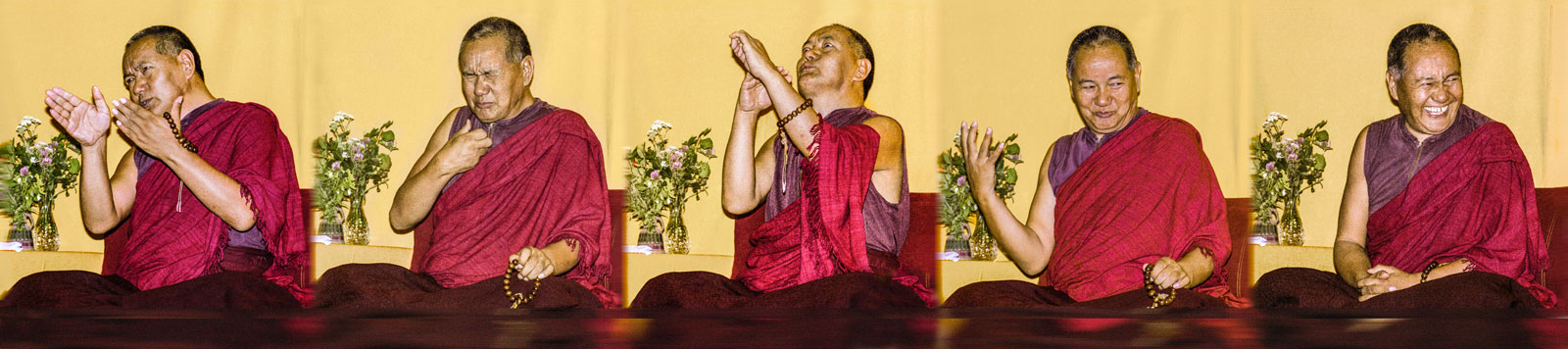
Lama Yeshe always emphasized the importance of nurturing a family feeling within the FPMT. In this same spirit, Istituto Lama Tzong Khapa (ILTK) in Italy invited Lama’s direct students from around the world to share their memories in celebration of what would have been his 90th birthday. We are working with ILTK to archive these valuable interviews—stay tuned for more updates on this project. In the meantime, we offer a glimpse of Lama’s skillful means through Ven. Sangye Khadro. The full video collection from ILTK, "Remembering Lama Yeshe,” is available here.
As you know, we're also spreading the family feeling by freely distributing more than a thousand LYWA books this year to over twenty FPMT centers and study groups—from New Mexico to New Zealand—as part of our new Family Feeling Project. Also keep an eye out for our Tools for the Path quarterly newsletter, which supports FPMT leadership. If you didn’t receive the September issue in your inbox, let us know and we’ll be happy to add you to the mailing list.
Big love,

Nick Ribush
Director and the LYWA team
THIS MONTH'S TEACHING: Your Mental Attitude

When we are not really wise but are instead narrow-minded, we generally think that what our mind is interested in is good, whereas what our mind isn’t interested in is bad. Even if we don’t actually put this thought into words, this attitude instinctively comes into our mind. So we should be careful.
Also, actions that arise from totally negative reactions are ignorant actions. However, if we do the same actions from thoughtful consideration, slowly, not hastily, they can be beneficial and lead to freedom. They can be a method, even though the action itself may appear outwardly to be totally ignorant. For example, you should wash your body every morning. According to some, washing the body can purify the traces of negativity. For a person who is devoted to the Buddhist path, that kind of method is a totally wrong conception. How can you wash away negativities by taking a bath? You can let go of your belief, or devotion, in that kind of doctrine by using your knowledge-wisdom. But in the case of a person who only practices morality—that is, who creates positive actions at the present time—there is no need to cause such a person to let go of his devotion to this method.
Many times it seems that European people always tell others whatever they believe because they think that is the only way. For example, saying that the Mahayana yoga tantra path is the only way to liberation. They always share these views with other people without checking others’ minds. “This way is the only way; not your method.” This is extreme; sometimes European people are extreme. They just go “boom” on others. They tell others whatever they believe, as if that alone is right. My point is that this is wrong, unless you have a good understanding that it will result in a good reaction in the other person’s mind. Then it is OK. Otherwise, you make other people more crazy. Instead of a good feeling, it becomes something negative, doesn’t it? You know this. We cannot say that one particular action is good for everybody. For example, what if you were to say that actualizing the wisdom of right view shunyata is the only way to reach perfect liberation? It is; this is true. But you should not communicate that kind of information to a person who isn’t ready for it. Instead of being beneficial it becomes totally negative, even though the information is completely correct. That’s why we say that what is right and what is wrong depends on the individual mind.
So you see, with narrow-mindedness, when you ask anyone, any samsaric sentient being, if something is good, if it is something outside their experience, they will often say it is bad. That’s how you can understand the human mind. The small mind is always complaining; it blames other people. Because it has little understanding, it is always judging. It will always judge another person who behaves differently from you as wrong. That causes great problems. This is a kind of discrimination. This is similar to how samsaric society thinks that everything should be uniform: everybody should sit the same, act the same, think the same. If you believe that way, then when someone acts differently, that person is criticized. He or she is seen as wrong. But there is no way that we can make samsaric life completely uniform in this way. We cannot; it is impossible. Why? Because every individual’s mind is different. Even if you try for such uniformity, it is wrong. You are hopeless.
This kind of samsaric society’s thinking is hopeless. You cannot think like this, because if you do, you are no different from samsaric society people. You are no different because you still have a narrow mind, and that has nothing to do with being a Dharma person. What is the purpose of judging he does this, she does that? There is no purpose. What purpose is there, for example, for the people of Kathmandu to talk every night about what people of other societies do or don’t do? You check up! Every night they only talk about other people’s actions. What is the point? It is a waste of time. It is really simple. I’m not complaining; just check up your own experience.
Therefore, according to Lord Buddha’s teaching, the discriminating mind is really the greatest cause of our problems. You should change that attitude. It’s better that you go with reality, the middle way. If you do not change your mental attitude, then what purpose do you think there is in practicing the Dharma? You should be especially careful regarding ideas about religions: this religion is good, this religion is bad and so on. How do you know what is good and what is bad? Especially, how do you know what is good or bad for the person you are talking to? Is it possible to judge whether this religion is good because this man in this religion is good? Be very careful.
Lama Yeshe gave this teaching in Bodhgaya, India, in 1974. It is published in Chapter 12 of Big Love: The Life and Teachings of Lama Yeshe. You can find it here on our website.