
Internal Vehicles: Mental Attitudes
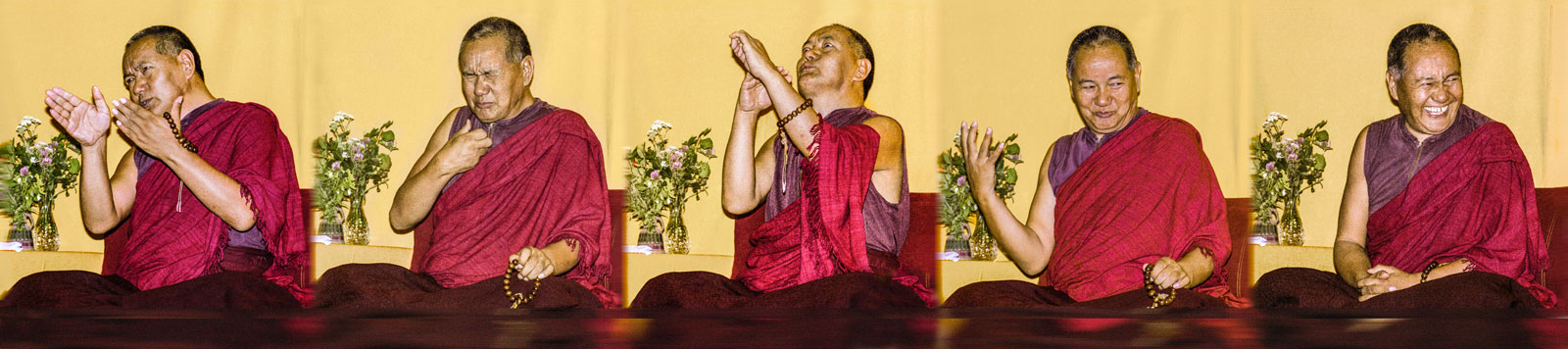
Lama Yeshe gave this teaching on the meaning of yana (Skt.), the vehicle that carries us toward enlightenment, at Manjushri Institute, 30 July 1977. This teaching is published in chapter 14 of Big Love: The Life and Teachings of Lama Yeshe.

What is a yana? It’s a vehicle—something that carries you from where you are to where you want to go; that leads you somewhere. Boats and airplanes are vehicles, but they’re external vehicles. A yana is an internal vehicle, a mental attitude. For example, if you want to go to New York, the desire to be there is your vehicle; that’s what leads you to New York. Similarly, a yana is that which leads you to your spiritual destination.
Actually, yana is easy to understand. We’ve been following some kind of vehicle since we were born. The desire to drink your mother’s milk to preserve your body is a vehicle. This kind of desire allows your life to develop in an organic way. Getting an education, for example, is also a function of your vehicle.
When you follow the Hinayana, you are mainly concerned with solving your own problems. You want to liberate yourself from your own confusion, and understanding the root cause of your suffering, you enter this path of self-realization. We call this kind of attitude Hinayana.
When some people, academics, for instance, talk about Hinayana, they interpret it as some kind of second-rate philosophy. You’ll often find books putting it down as a philosophical doctrine. That’s a mistaken attitude. Now, look at us Tibetan Buddhists. We’re always talking about Mahayana and bodhicitta, but if we were to check our minds closely, we’d find so much self-cherishing and “me, me, me, me, me” that—forget about calling ourselves Mahayanists—we wouldn’t even qualify as Hinayanists.
Hinayana and Mahayana are not philosophy or doctrine. Of course, you can give philosophical interpretations of these paths, but their real meaning is psychological; they’re to do with states of mind. Realization is not philosophy. Yana is not to be found in a book; yana is mental attitude. If you have tremendous concern for your own problems and an intense desire to free yourself from them completely and attain individual liberation, or nirvana, your attitude is Hinayana.
Things may not be as simple as we think. We believe we are following a spiritual path; we think we are meditators. But if we really check carefully, we will see that following the path to liberation is not an easy job. First and foremost, we have to understand what the root of samsara—cyclic existence, the wheel of life, death and rebirth—is.
Even in this life we do so many things to be happy but nearly always end up miserable. We go to the East seeking religion and end up miserable; we go to a center of this religion hoping to find relief and again end up miserable; we go to a center of that religion hoping it will solve our problems and end up miserable yet again. We run from one spiritual trip to another and always end up miserable. So we get fed up with religion and decide to be free, just like normal people are. We party, we go out drinking and dancing, we have this girlfriend, that boyfriend, one partner after another, but all we get is more and more confusion. This is samsara, the circle of endlessly substituting one sense object for another, never finding satisfaction; changing, changing, changing, but it's basically always the same thing.
Actually, we are like children. Children run from one thing to another, easily losing interest, easily distracted. We think children are, well, childish. But if we stop for a moment and cast a penetrating eye at our own trips, we’ll see how childish we ourselves are. Forget about past lives; forget about future lives; even in this life, how many trips have we been on? How many vehicles have we taken since we were born up until now? I can guarantee it’s thousands upon thousands. And if you check honestly, you’ll find that practically all of them have ended in disillusionment, with no satisfactory conclusion. What do I mean by satisfactory conclusion? I mean a clean-clear conviction, an indestructible determination that, “Yes, this is right for me.”
But that’s not us. We’re like yoyos. We go to one religious center and the priest or guide or lama or yogi tells you that your philosophy is completely wrong and that his is the right way to think. So, you believe you’re wrong and try to think his way. Then you go to another place, where they also tell you, “No, that way’s wrong; you should think like this” and explain some other philosophy. Again you think, “Everything I just learned was wrong.” You’re tossed between right and wrong, wrong and right, and finish up more confused than ever.
Now you come to this Tibetan Buddhist center and hear that from a higher standpoint, not only the samsara trip is wrong but so too is the nirvana one. Going to a meditation course to hear a spiritual teacher talk about the path to liberation is supposed to be right, but we’re saying it may not be. Again, it just adds to your confusion and you’re no closer to a clean-clear conviction that you ever were.
However, to enter the Hinayana vehicle, the least you should have is a realization of renunciation of samsara. That’s actually an incredible accomplishment. Someone who has realized renunciation of samsara is an object of refuge; someone to whom we should prostrate. It’s very rare to find someone who has that realization. That’s why when I explain the Hinayana path you should not think I’m putting it down. Reaching the level where you have entered the Hinayana path is a very high achievement.
I hope, then, that the meaning of yana is now clear. As I said, you can give doctrinal interpretations of the Hinayana and Mahayana paths. For example, certain Hinayana schools, like those in Thailand and Sri Lanka, require the monks to adhere to a very strict code of discipline. Monks cannot look women in the face and they certainly can’t touch them, not even to shake hands. If a monk touches a woman he has automatically broken a rule. In many ways, it’s a good rule, but from the Mahayana point of view, it actually depends on the mind; it depends on the attitude with which you touch the woman. If you touch her with a mind of grasping attachment, the only result of which is more conflict in your mind, that’s wrong. But if you touch her out of compassion, to benefit her in some way, we believe that that’s not only acceptable but necessary.
Now, some people will look at these two teachings and conclude that Lord Buddha contradicted himself. One vehicle says no; the other says yes. There’s no contradiction; it depends on the individual’s mind. That’s what’s important.