
These teachings were given by Lama Zopa Rinpoche at the Third Kopan Meditation Course, October-November 1972, and the Fourth Kopan Meditation Course, March-April, 1973, held at Kopan Monastery, Nepal. Lightly edited by Gordon McDougall.
Visit our Kopan eBook Series page to read more about the Kopan eBook Project and to find links and synopses for all the Kopan ebooks published to date

1. Only the Dharma Can Bring Perfect Peace
The Fourth Meditation Course: March–April 1973
With Buddhists, it isn’t so much a matter of how we began on this planet as much as it’s a matter of how the mind began. Since the answer to such a question is incomprehensible to our ignorant minds, we say that mind is beginningless.
If we ask why the mind exists, or even existence for that matter, we could answer that the mind exists to perceive its own nature, which ultimately is the absolute true nature of reality or existence—that is, the truth that is devoid, or empty of, any intrinsic self or “I.” In tantric visualizations, we make the body one with Guru Shakyamuni Buddha’s holy body and the mind one with space, like his fully enlightened mind.
Guru Shakyamuni Buddha gave three levels of teachings to those with three different levels of intelligence. At Sarnath, he gave teachings to beings of lower capability. Near Bodhgaya, he gave teachings to those of higher capability—the teachings on emptiness or absolute truth. At a third place, he gave tantric teachings. At the same time Guru Shakyamuni Buddha appeared in different forms to different people—as a bhikshu, as a king and so forth, as was fitting to their minds.
Before meditation we must understand the Dharma to understand that we are suffering. Our minds have been asleep, sleeping comfortably within the truth of suffering, although perhaps not as comfortably as in American hotels. From the tiniest insects, seen only through the microscope, to the most famous person, who owns the whole earth, all living beings are conditioned by suffering, or dukkha. There is no choice to not experience suffering—even a king who has great power and is supposed to be perfect has no choice but to suffer through samsara.
Because our minds are not aware, not open, we do not see the Dharma, and we’re unable to avoid the various kinds of suffering. Has there ever been anyone since the beginning of time who has avoided death? All those past kings and presidents are now dead, only their names remain—their minds are somewhere else. Also, there is no choice not to become older—aging begins in the mother’s womb. This is the nature of impermanence—as something comes into existence it changes; it’s all suffering. Taking rebirth without choice is also suffering. Exactly the same thing is true for animals and insects—they have no choice but to experience suffering. Some sicknesses can be temporarily cured by medicine, but this is never certain, and some can’t be cured. This is the logical experience of reality.
The sufferings of living beings are incredible—there are so many kinds. Dissatisfaction is suffering. No matter how many material possessions people have, they are never satisfied. In fact, one of the eight types of sufferings is that of not getting what we want; whatever we have, it’s never enough. This fundamental suffering is extremely difficult to overcome, and it’s one of the main sufferings of human beings. Longing for ever more material possessions keeps us busy; we are never finished collecting things for ourselves. And we can see the things we have are no longer new and attractive; they are only getting older and older. That is the nature of impermanent things.
Every problem arises from the inability to recognize that our mind is in the nature of suffering, causing us to have attraction and aversion for others without control, just as we lack control of rebirth, old age, sickness and death. Not recognizing the true nature of our mind, we keep ourselves busy day and night, supporting the body, which is also in the nature of suffering. That arises from the suffering mind.
All the material development there has been over the many centuries has not helped to stop uncontrolled death or old age or rebirth. What can cease this suffering? We have to find a way.
The real peace that we seek is control of and freedom from rebirth, old age, sickness and death as well as all of our other problems. Peace from the Dharma point of view means the cessation of karma and delusions but achieving this is not easy. It depends on recognizing the cause of these problems. All of them are causative—everything has a reason for happening and for its existence.
The principal causes of our problems are the three negative minds: greed, hatred and ignorance. These are not external, physical things, but internal states of mind. Real, perfect peace depends on recognizing these three minds and the sufferings that arise from them and overcoming them.
We must have a method to achieve this perfect peace, and the only method to bring this peace is the Dharma. Only the Dharma can free us from the three negative minds. No external, material method or development would ever be able to cut the suffering result and its cause forever. It has not done this so far, nor will it in the future.
For example, when animals or humans feel hungry, they think that the principal cause is lack of food in the stomach. Then they eat food, but in a few hours the hunger recurs. From the time of our birth until our death, the cycle of eating, making kaka, getting hungry and eating has continued and it will do so even if we live for a thousand years. This means that the solution of eating is not a permanent one for hunger, therefore it’s not the best solution. There must be a reason for it.
Since food doesn’t solve the problem forever, the lack of food is not the principal cause [of the suffering of hunger]. There must be some other cause that is independent of external things. The principal cause is greed, hatred and ignorance. If we apply this example to any other problem, we will see that as long as the external solution does not cut off these three negative minds, there can be no cessation of the suffering result. Because external conditions can’t cut off the principal cause, they can’t stop suffering. Even being on the moon or on Venus is only a change of place, an external thing. However we try to change things externally, it can’t help to cut off the problem. We have to check up inside. By understanding the cause of our problems, we can open the door to the solutions.
This doesn’t mean that we must reject external material development. It can be important, and every country should be developed both internally and externally. It can bring peace if the people of a country can develop both materially and internally. With that, that can bring peace to their country and to other countries, peace for all beings. If politics could be inseparable from inner development, then real peace would definitely be possible. The problem is the lack of spiritual development. Having material development alone can only cause problems for our own and other countries. Perfect development is, therefore, internal development together with external development.
Dharma, which in Sanskrit means “that which holds (us from suffering)” is the method by which we can cease the cause of all suffering on every different level. Within the Dharma itself as shown by the Enlightened One, the Buddha, there are many different methods to bring this about. Why did he show us how to practice in this way? Because there is ignorance. As long as ignorance exists in the form of even the slightest unknowing mind, there’s definitely a need for Dharma practice. If such an ignorant mind didn’t exist, there would be no reason to practice Dharma at all because we would be permanently free from problems.
Dharma practice is the cultivation of a positive, pure mind and of the actions produced by a positive, pure motivation, the motivation for truth and peace. Simply put, any action that helps us to cut off suffering results and their causes is a Dharma action, inseparable from our spiritual development. Material development alone cannot bring peace. It can only bring peace if it, too, is inseparable from spiritual development. We don’t have to wear robes to engage in such actions.
We can think of certain medicines that can be poisonous and dangerous or medicinal and restorative depending on how they are used. In the same way, actions can be Dharma or non-Dharma. Just as we need understanding and skill to use a substance as medicine so that it can bring benefit, we need understanding and skill, or wisdom, in order for our actions to bring about positive results. If we lack this understanding and skill, even what appears to be a Dharma action can bring about a suffering result.
Therefore, to practice the Dharma we must first of all understand the mind. Unless we do, we will be unable to meditate, and the door to enlightenment will remain closed. Understanding the mind is the door to all past, present and future happiness, to every realization, the door to every perfection.
THE CORRECT WAY TO LISTEN TO THE DHARMA
Learning the Dharma isn’t the same as studying in schools and universities, which are done with worldly thoughts, expecting worldly comforts. The objectives of studying the Dharma are not the same. The objectives of our Dharma study should be higher; unless they are, we’re simply wasting our time. Our knowledge will only work in a positive way depending on our motivation. If we try to gain knowledge in a positive way, the effect will be positive. If not, the result will only be suffering. The serious Dharma practitioner appreciates the great importance of generating a positive motivation.
The subjects that we study during our Dharma education are hard to understand, taking years, so we must not become discouraged and give everything up if the results don’t come immediately. As we continue our meditation, practice and study, understanding will slowly come.
It’s also important to remember that any difficulty we have is caused by our ignorance, not by the subject matter. If we abandon the subject, we waste our human life with its potential for great realizations. Were we to spend our whole life in ignorance of the vital Dharma subjects, we would die with a mental state no better than that of an animal. The very lowest state of mind that we should die with is happiness—the lowest purpose of human life is not to suffer after death.
To reach enlightenment, the way to study the Dharma is like this:
- Listen carefully to the subject matter.
- Check up to eliminate doubts; contemplate, ask and discuss.
- Meditate, making the mind one with either the object or the subject of meditation and becoming habituated to it.
[Meditating on patience, for example, is to eliminate anger, so that is making the mind one with the object.] Meditating on bodhicitta is done for the purpose of making the mind one with it, as is meditating on the different manifestations of enlightened beings, which is making the mind one with the subject.
Meditations vary. If we doubt a particular meditation will be successful, by checking and observing in the right way, we will be able to understand its benefits. If we still have doubt about this after checking, we should ask someone who knows the subject well.
Single-pointed meditation involves single-pointedly concentrating on one object of meditation, which may be any internal or external object, and habituating the mind to it by controlling the distractions. The more the mind gets accustomed to this, the fewer disturbances will arise.
Because we have created them from beginningless time, it’s very easy to engage in negative actions—the impulse to do so arises in our minds effortlessly because we are so used to them, so familiar with them. Images of the objects of the negative emotions arise so easily and our negative mind wants to dwell on its objects. Holding a positive mind is so much more difficult to do.
As the teacher or guru gives the teachings, we should take those words as a mirror in which to check the reflection of our own minds. Just as we would check in a mirror to see if our face is clean or dirty, we look at our mind in the reflection of the lama’s teachings to measure our personalities, behavior and so forth. And just as we don’t use the mirror to check another person’s face while leaving our own black and dirty, we shouldn’t use the teachings to check the faults of others. The teachings are meant to be used to clean our own mind and enlighten ourselves for the sake of sentient beings. They aren’t meant to be used to help us to see others in a negative way.
As we listen to teachings, we should check our own mind, asking ourselves whether we are doing what the teachings advise or not. We should compare our own states of mind to the realizations described in the teachings. We should always try to do this. Even if we have no experience of what the teaching talks about, it’s still important to try.
We should not become bored with listening, bored with hearing the same words repeated. Just to hear the words of a teaching is not the Dharma. The actual study of the Dharma is not studying the words but rather making the mind one with the object and trying to realize the subject through practice, for we must achieve the many levels of realizations that lead to enlightenment. It’s possible to study the Dharma for samsaric reasons, with pride and an egotistic mind, only knowing the words and then telling them to other people.
We should check up. No matter how many times we have heard the subject matter in the past, if we have not gained any realization of the topic we should continue to practice it. Until we experience that realization, we can’t hear it enough. And even if we have gained a realization of a particular subject, that realization still has to be developed until we attain enlightenment. Even though advanced practitioners might have realized a particular subject and are living in the practice—even though they have heard it a hundred times before—they still keep listening in order to develop their realizations. We shouldn’t be satisfied with words alone; even a parrot can be taught mantras.
So, we should take up the mirror of the teachings and check our mind to see if we find any defects. The teachings are the mirror of the mind and the subject matter they address is primarily negativity and suffering. If we find that our mind has such defects and problems, we should try to avert and overcome them. Our job is to clean away any negativities in our mind.
This is the way that serious practitioners listen to the teachings. This is how our gurus instruct us to practice. We shouldn’t have pride, thinking, “I know this subject, why does he repeat it again and again?”
MEDITATION
[WFGS, pp. 75–82]1
There are two types of meditation, and the attainment of enlightenment is totally dependent on both, therefore each is important.
- analytical or checking meditation, in which we analyze the subject to come to an understanding
- single-pointed or fixed meditation, where the mind stays single-pointedly in its object
Analytical meditation is most helpful at the beginning of our practice. This kind of meditation expands the knowledge of the mind, clarifies the nature of the object and enables us to gain correct understanding and realization. Without this kind of analysis, the possibility of wrong understanding is great.
In single-pointed meditation, the mind is unified with the subject of meditation and thus becomes familiar with it. The goal is to maintain this concentration for an increasing amount of time, which reduces any distraction or dullness we might otherwise experience.
Physical discipline can aid the development of this kind of meditation. When sitting, we should take the position of Vairochana, one of the Dhyani Buddhas. This position both prepares us for meditation and also inspires others. Our legs should be crossed as comfortably as possibly, with a straight back and level shoulders. Our mouth should be closed, our teeth as usual, and we should place the tip of our tongue against the back of our top teeth. We should place our hands in our lap with the two thumbs touching, which is symbolic of preparation for future tantric realizations. Our eyes should gaze down the line of our nose, and our arms should be held in a round shape. Then we should concentrate on breathing through the nose as follows.
Visualize that the suffering of all sentient beings is inhaled through the left nostril in the form of dark smoke and fog. When the smoke and fog reach the heart, they become like the sun burning all negative minds and actions.
Visualize that our entire body becomes clean, like transparent white light that passes out through the right nostril to all sentient beings.
Then visualize that the breath leaves the right nostril in the form of light, reaching every sentient being and transforming into all of the things that they need. Visualize that through their enjoyment of those things, all sentient beings receive perfect peace.
Repeat these steps making three times in total and repeat three more times, beginning with inhaling all the negativities of sentient beings through the left nostril, and then visualizing light passing through the right nostril.
This breathing meditation can be very powerful—like an atom bomb that destroys the delusions of our own negative minds, such as the belief in the ego. If we practice this way with strong bodhicitta, this practice becomes like a shortcut to enlightenment. However, this is very difficult to do in the beginning since we are so lacking in our understanding of bodhicitta, which must be pure and sincere in order to give this method of practice its greatest meaning.
This practice can bring about the purification of our own delusions and negativities. As well as not wasting our body, we don’t even waste our breath because we use this meditation and our breath for other sentient beings to develop bodhicitta. As purification is necessary for the success of our other meditations, this practice can become a support for those as well. The degree of purification that we experience as a result of this practice depends, of course, on the depth of purpose that we apply to it, which in turn depends on our own will.
Up until this point, our mind has been mostly distracted, wandering around unsubdued and driven by superstition, as uncontrolled as dust blown through the air by the wind. In order to meditate properly, however, on any subject, our mind must be prepared—it must be clear and peaceful. The breathing meditation gives us this basis.
The meditations of the course [as shown in Wish-fulfilling Golden Sun] are in opposition to worldly superstition. To bring our mind to a positive place, to make our thoughts positive is very difficult. As long as our mind is in a negative place, it cannot be in a positive place simultaneously. We need a skillful method to bring us there—a tricky method to play with the negative mind.
Why do we have negative thoughts and distractions? They have so much control over us, and we find it so difficult to control them. Even to concentrate single-pointedly for five minutes is difficult—so many other thoughts arise. All this is because the mind is so accustomed to being distracted, so habituated to existing and functioning in that way. Our mind is greatly obscured by superstition and has been throughout beginningless lifetimes.
Actually, in breathing meditation, the breath itself is not so important. What we are really trying to work with is the mind.
Keeping our breath natural—slow and gentle—we breathe in and think, “All sentient beings are extremely precious, they are most kind, they are the source of all my past, present and future happiness, including the perfect happiness of the realizations that lead to enlightenment. They have cared for me up until now and will continue to do so in the future, and they are more important than my own life. Therefore, I take all of their suffering and negative minds into myself in the form of smoke through my left nostril. As it enters it becomes light, like the sun, so that all wrong self-cherishing and all other negativities are burned and disintegrated, and my whole body is cleansed, becoming transparent and full of light. My entire body and mind are one with great, infinite, immeasurable happiness.”
Then, breathing out, we visualize countless rays of white light, and think that this light is sent out to each sentient being, fulfilling the needs of every single one. As a result, every suffering and cause of suffering that they might experience is completely purified, and they attain the state of enlightenment.
Meditation is not dependent on words. We can’t transplant realizations and they aren’t already in the mind. In order to have realizations, we must make meditation a practice, not just close our eyes. Practice is the best meditation. In order to practice, we must receive an explanation of the subject we will practice. Once we have listened, we should check their meaning and try to understand them, using the methods that we have been taught to gain greater understanding. Through constant repetition, we try to see the subject of our meditation increasingly clearly. Then, our practice will deepen. Feel … experience … realize. This is the practice of meditation.
Therefore, the practice of meditation does in fact depend on words at the beginning, but the realizations will not arise immediately. The length of time it takes to develop realizations is dependent on our karma and our level of intelligence.
As we practice, it’s important to remember not to rush. We are trying to gain realizations through practice, not trying to finish something. We are trying to explore the subject in a deeper way. We should do so slowly, trying to control the distractions within our mind. This depends on our skill. We first remember the outlines of the subject we have been taught, and then we amplify them. This is the best way to develop the wisdom of any subject.
Before we can get out of samsara, we must develop a realization of emptiness. The development of emptiness must be supported by the merit of many positive actions, the practice of discipline and the purification of the negative mind.
Following the practices of the three vehicles [the Hinayana, the Mahayana Sutrayana and the Mahayana Vajrayana] leads to better rebirths and freedom from the three lower realms. The practice of each brings increasing realizations. We must especially develop the realization of the absolute truth. If we follow the disciplines carefully each time, we may be able to complete this process within sixteen perfect human rebirths.
HOW ENLIGHTENMENT IS POSSIBLE
[WFGS, pp. 25–28]
Mind is beginningless. Negative minds arise from previous negative minds—the negative mind of this present life arises from the negative mind of the former life. There is no first life. If we hadn’t existed before the creation of this earth, it never would have been created, as the earth is a creation of our own minds and karma.
Mind is defined as that which is clear and has the ability to perceive objects.
Delusions are that which disturbs the mind, keeping the door closed to perfect happiness, the complete cessation of suffering. Delusions are temporary negative minds and can be ceased. They see the object in the wrong way, in a way that is in direct opposition to the reality of the object.
The mind has continuity, in the same way as a seed has the ability to produce a plant and another seed, and so on. As it’s not possible to have a seed in one place and a plant in another, it’s only through the development of our own mind that we can achieve enlightenment or perfect peace. The relationship between the development of the mind and enlightenment is the same as the relationship between the seed and the plant. The seed develops in association with the necessary elements and this produces the plant. The development of the mind is our own creation, depending on our decisions. Perfect peace cannot be given by a buddha or a lama, nor can it arise from the use of drugs and so forth.
How does Guru Shakyamuni guide his followers? As is said in a teaching,
The Great Ones do not wash away sin with water;
they do not rid beings of suffering with their hands;
they do not transfer realizations of suchness onto others.
They liberate by teaching the truth of suchness.2
The Buddha guides and releases sentient beings from suffering, from the cycle of death and rebirth only through showing the absolute truth. In order that we might realize this, Guru Shakyamuni Buddha also presents many other teachings such as those on the suffering nature of existence, impermanence, great love, great compassion and bodhicitta. All of these teachings lead to the realization of emptiness, the absolute truth.
However, a direct realization of emptiness doesn’t come solely by being shown these teachings by a teacher. To do that, we need to study, practice, and transform our mind into these teachings, into the essence of the Dharma. Only through the continual practice of right understanding can we become free from samsara and attain enlightenment.
The pure, clear light nature of mind is not one with ignorance. If that were the case, it couldn’t be purified. The ignorant mind couldn’t be transformed into an enlightened one. Ignorance refers to the obscurations that prevent enlightenment. Because ignorance (marigpa in Tibetan) means unknowing, how could it become the fully knowing mind (rigpa in Tibetan)? Just as a dirty cloth can’t be dirty and clean at the same time, but it can be cleaned, our mind, which is currently dirty with delusions, can be cleaned of its impurities. If the mind were one with ignorance, there would be no way to achieve understanding. Our delusions are always obscurations to the realization of enlightenment. We are not trying to make ignorance enlightened. The intrinsic nature of the mind is not one with ignorance, rather it is obscured by ignorance, which degenerates the positive qualities of the mind and makes us forget.
Our present obscured mind has a relationship to our future omniscient mind because this obscured mind will become the completely purified, omniscient mind in the same way that a seed has a relationship to the future flower that will grow.
Although we have been alive for so long, we still don’t know what life is. The mind is a great luggage of impressions, packed up from previous lives. The way that we perceive the external world depends on the karmic seeds that ripen at any moment. An enlightened mind contains only enlightened knowledge, the complete collection of merit—good karma—and the complete purification of negativity. Therefore, the enlightened mind arises from karma although its actions are not karma dependent. The negative mind, on the other hand, has never been enlightened.
Notes
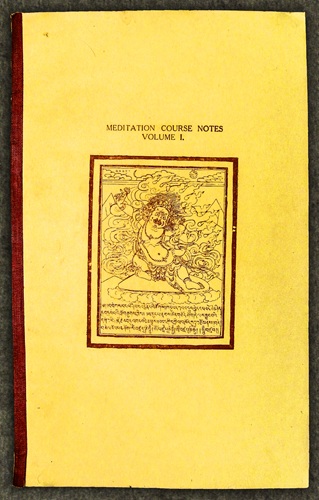
1 During the course, Rinpoche worked from a “work copy” of his first Dharma book, Wish-fulfilling Golden Sun. The page numbers here and afterwards refer to the sections in the 2016 re-edit of the book, available at lamayeshe.com. [Return to text]
2 Quoted in Liberation in the Palm of Your Hands, p. 247. This is commonly attributed to a quote in Prajnavarman’s Commentary to the Collection of Uplifting Sayings, although this is not verified. (See also Liberation in Our Hands, vol. 1, p. 11, fn. 11.) [Return to text]